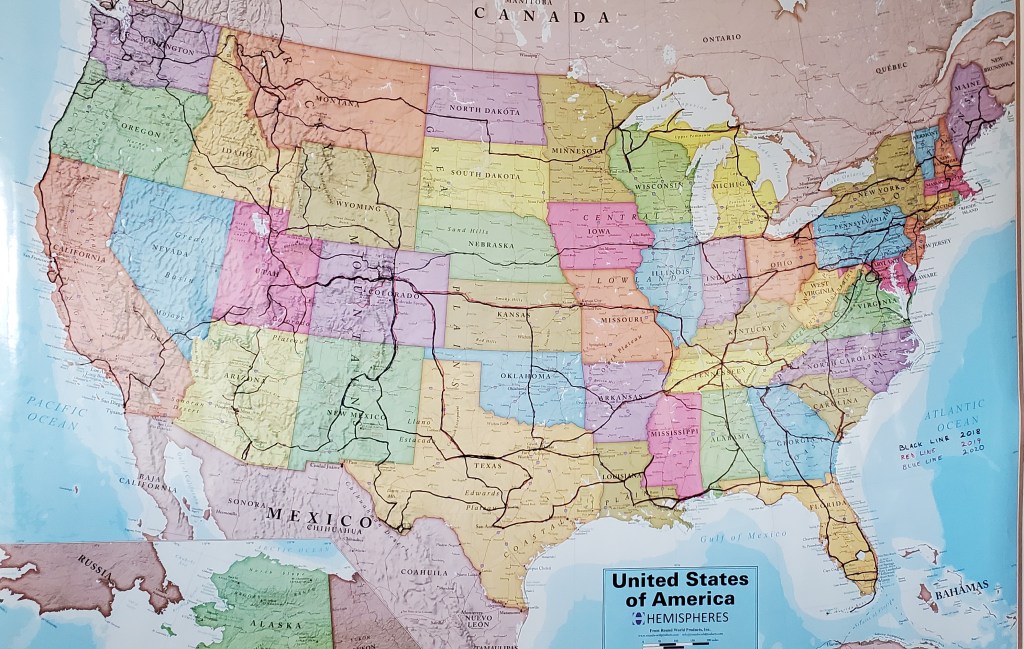
We are coming up to our 3 year anniversary for RVing life. Our plan was to see as many of the National Parks the West in 2018, the East in 2019 and pick what ever we missed in 2020. The photo above is the map that Tom keeps track of our travels across the US. Here’s a quick recap of our statistics:
- Total miles of rig travel: 39,668 (the rig didn’t take the trip to southern Florida, one time we drove just the truck and another we flew)
- Drove through/visited 47 of the 48 lower 48 (only missing Rhode Island)
- Visited 5 of the 10 Canadian Provinces (none of the 3 Territories)
- Visited 44 of the 53 National Parks in the Lower 48
- 12 parks are Alaska (8), Hawaii (2), American Samoa & St. Johns Virgin Island
- 9 parks we still need to visit in the lower 48
- You can pretty much see the areas that we are missing for the National Parks…the central west (NV-Great Basin, CA-Sequoia, Kings Canyon, Yosemite, Pinicals, Lassen, OR-Crater Lake, SD-Badlands & Wind Caves, plus the new one in WV-New Bridge)
- Our goal for 2021 is to finish the lower 48 National Parks
- We don’t have plans for Alaska at this time, but we will get up there in the rig. Although, we have no idea how many of the 8 National Parks we will be able to visit.
- 6 parks have been upgraded to National Park status since we started planning our traveling adventures a little more than 3 years ago
- Travel time (includes 3 trips not taken in the rig) on and off through out each year
- 2018 – 6 months away from home, 177 days in the rig
- 2019 – 6 months away from home, 163 days in the rig
- 2020 – 4 months away from home, 127 days in the rig
- Average Accomodation Cost = $35.50/day
- Includes campgrounds, memberships for reduced camping fees and mooch-docking (staying at family or friend’s property at zero cost)
- My goal/budget for nightly stays is $50/night. Sometimes we spend more, espcially in popular cities or special locations like water side with a view. I have been able to bring the average cost down to $35.50 with memberships to camping groups as well as mooch-docking.
- Types of campgrounds we prefer are listed below. We don’t stay anywhere that doesn’t take reservations.
- State Parks: Usually well run, in beautiful areas, spacious sites and reasonably priced. Often do not have full hook ups, but we do fine with just electricity. They need to be booked anywhere from 4-6 months out, but I have been able to get a few last minute bookings off season in the middle of the week. Reservations.gov pretty much handles all the state parks in the US.
- National Parks: We can rarely get into these campgrounds unless I am planning almost a year out. Very similar to State Parks, but often no full hook ups, some size limitations and super challenging to reserve.
- KOA RV Campgrounds: Usually consistent as far as ratings and amenities. RVs pretty much lined up along roads and reletively close together, but this is the norm for most private RV Parks. Very easy to get as you are traveling across the US, good for a night or two or in big cities. The Nashville KOA has shuttles that take you into the downtown area for a small fee.
- Private RV Parks that have great ratings or recommendations
- Thousand Trails: We have been buying their annual membership the past 2 years and I discuss below. Nothing to get too excited about.
- Boondocking: Boondocking is considered camping without hookups.
- Walmart or other store or rest area parking lots — great if you are making time across the US and roll into a town later at night and want to leave early in the AM. We have done this a few times and love the convenience.
- Harvest Host — See more info below
- BLM Land or Federal Land in remote areas (off-grid) — that’s the REAL camping that a lot of folks love. We have not tried it yet, but plan to.
- We have boondocked in the US and Canadian National Park system, but we seem to use quite a bit of battery power when we aren’t plugged into electricity. We have a solar panel, which is helpful on sunny days, but you have to move it around to optimize the sunlight. We borrowed a generator for the the first two years, but they are loud, obnoxious and usually have limited hours as to when you can run them. We are thinking about how to improve our boondocking ability if we find we really want to do more serious camping off-grid.
- Federal Lands Campgrounds: I have a friend who stays in these campgrounds all the time, but they have a Class B Sprinter Van and don’t mind staying without power. They are usually more rustic campgrounds that we are too big to get into.
- Finding accomodations/campgrounds is much harder that picking out a hotel. In general there aren’t centralized reservations systems like Hotels.com. Campgrounds under the same francise or ownership can be found on one website for mulitple locations and the state and national park systems have great reservation websites. Many smaller locally owned campgrounds require a good old fashion phone call for a reservation.
- Google, Yelp and Trip Advisor reviews are priceless, but need to be taken for what they are. I try to always stay in at least 4-star campgrounds. I can usually discern when noise from the highway or trains will bother us or not. The one review I didn’t take all that seriously was for a KOA in Santa Rosa, CA that complained about peacocks and their noise. I thought, surely they can’t be that bad…well, yes they are!
- I make reservations ahead of time everywhere we stay. We plan out our route and I usually make reservations for most of the trip. We rarely just wing-it to see where we want to end up for the night as we don’t want to drive into a campground with a 35′ rig that doesn’t have room for us. That being said, we are always open to changing our plan, canceling or moving reservations, which we do frequently.
- We have not done First-Come-First-Serve at this point. We have seen other folks camp near by with a reservation and then lurk in the desired campground that is First-Come-First-Serve to secure a campsite BEFORE they bring their rig into that campground. We might try that in the future.
- The cost of changing reservations is usually not that much and worth the peace of mind knowing where we will sleep each night.
- Memberships we have had and my thoughts on them:
- Good Sam’s Club – $29/year, but reduced rate for more years: gives you 10% each time you stay in a campground that supports the Good Sam membership, plus you get additional savings at Camper World, which we shop frequently for RV related items. No limitations. I am pretty sure we get our membership cost in savings.
- KOA Membershp – $33/year: 10% off at KOA campgrounds plus you earn points that go towards free nights at KOA campgroups. No limitations. Definitely worth the cost as we stay at a lot of KOA campgrounds, especially as we travel across the USA.
- Passport America – $40/year, with savings as you add years: Reduced rates up to half price at participating campgrounds. We definitely saved the cost of this membership, but the rules that you have to follow are a pain and often incovenient…can only stay 1 or 2 days at the reduced rate, days available at the reduced rate are only mid-week, seasonally popuar campgrounds not available during high season. I spend a lot of time reading all the rules before I book.
- Harvest Hosts – $79/year, but they always have deals to bring it down to $50: Harvest Hosts has gone around the USA and Canada and found wineries, breweries, small farms, small/rural museums and golf courses who will allow you to boondock (stay without water/electric/sewer hookups) for one night at no cost other than they would like you to support their business by making a purchas of their goods.
This is a fun membership as you get to stay on the grounds of wineries or farms in usually beautiful areas. But there are plenty of restrictions…usually cannot stay more than one night, need to call ahead to ensure they have room for you and don’t have a special event, randomly scattered across the USA and often off the beaten path for through travel, only open ceratins days, need to be in place by a certain time, etc.
We find that we can spend more than my budgeted $50/night if we really like their wine! That being said, we stayed at a Memmoite Blueberry Farm in Nova Scotia and paid $6 CD for a pint of blueberries, had a lovely tour of the farm and spent a quiet night out in their field. Harvet Hosts is definitely part of the adventure! - Thousand Trails – many levels of membership, but we just signed up for our 3rd season at $500 for the basic year membership, which allows for you to stay in their campgounds in the ZONE that you picked (we picked SW to hit CA for this spring). You can spend an additional $300/year for additional campgrounds that are often a little nicer, which we have the last 2 seasons and probably will at some time this year.
This membership is great for those who travel a lot for longer lengths of time, have campgrounds in the area that you are visiting and you have the fortitude to follow all their rules. The level of membership we purchase is pretty low on the priority totem pole, so the fact we often travel on the shoulder seasons allows us to use the TT campgrounds when we are in the area. We can only reserve 60 days out, which is tough for the more popluar campgrounds in high season. Some of the campgrounds are dated and not that maintained, but others are great. We got our money’s worth the first season, we did not the second season, but that we due to Covid an the fact we ended up canceling our spring trip to Oregon and Washington that was going to in TT campgrounds. There are a lot of rules with this membership as well.
Stay tuned for the next recap on some of the problems we have had!
 The Traveling Lounsburys
Pretty impressive. You should write a book
LikeLike